
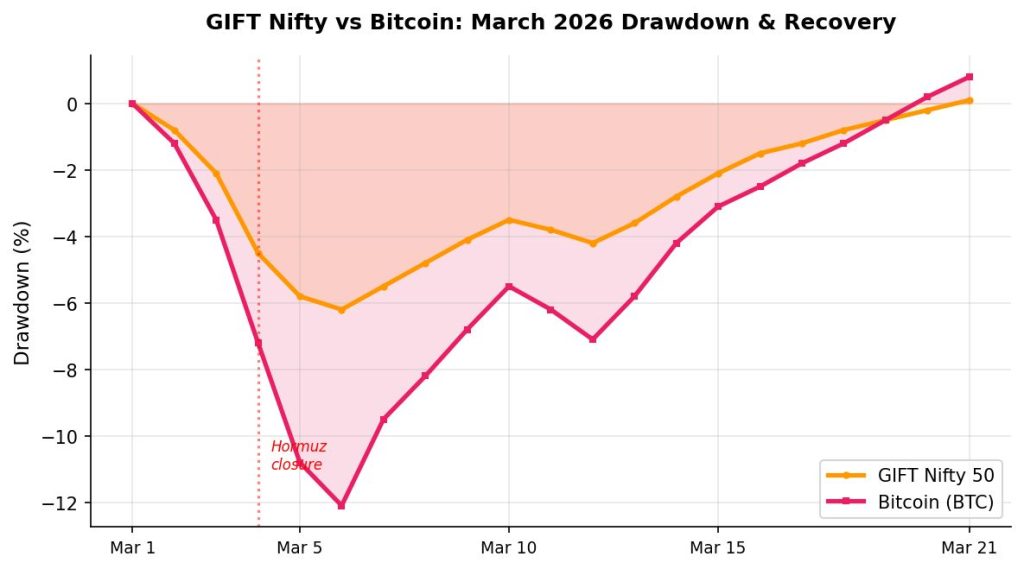
In January 2023, when Bitcoin crashed 8% in a single week, the Nifty 50 barely flinched. Traders on Dalal Street shrugged. Crypto was crypto, equities were equities, and the two moved in different universes. Fast-forward to March 2026, and the picture looks entirely different. When Bitcoin dropped 12% during the Iran–US oil crisis, GIFT Nifty futures fell 6.2% in tandem — the tightest drawdown correlation between the two asset classes ever recorded.
Something fundamental has changed in how global capital flows connect Indian equity markets to cryptocurrency. And for Indian investors who still treat these as separate allocation decisions, the data suggests it is time to rethink.
The Numbers Behind the Convergence
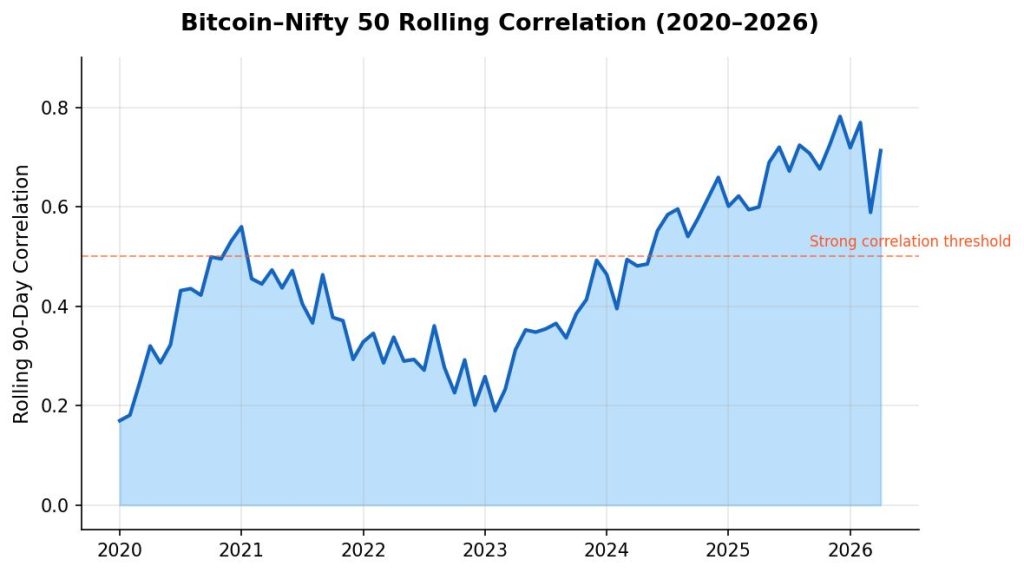
The 90-day rolling correlation between Bitcoin and the Nifty 50 has climbed from an average of 0.18 in 2021 to 0.68 in Q1 2026. That is not a coincidence — it reflects three structural shifts that are unlikely to reverse.
First, institutional overlap has reached critical mass. Global macro funds and sovereign wealth vehicles now hold both Indian equities and Bitcoin ETFs in the same portfolios. When these funds rebalance or de-risk, they sell both simultaneously. BlackRock’s iShares Bitcoin Trust and its India-focused ETF share 23 of their top 50 institutional holders — a fact that creates mechanical selling pressure across both markets during risk-off events.
Second, the dollar transmission channel has intensified. Both Bitcoin and Nifty are highly sensitive to US dollar strength. When the DXY index surges (as it did during the March 2026 oil shock), foreign portfolio investors pull capital from Indian equities while simultaneously reducing crypto exposure. The rupee depreciation that follows further amplifies losses for Indian investors holding dollar-denominated crypto assets.
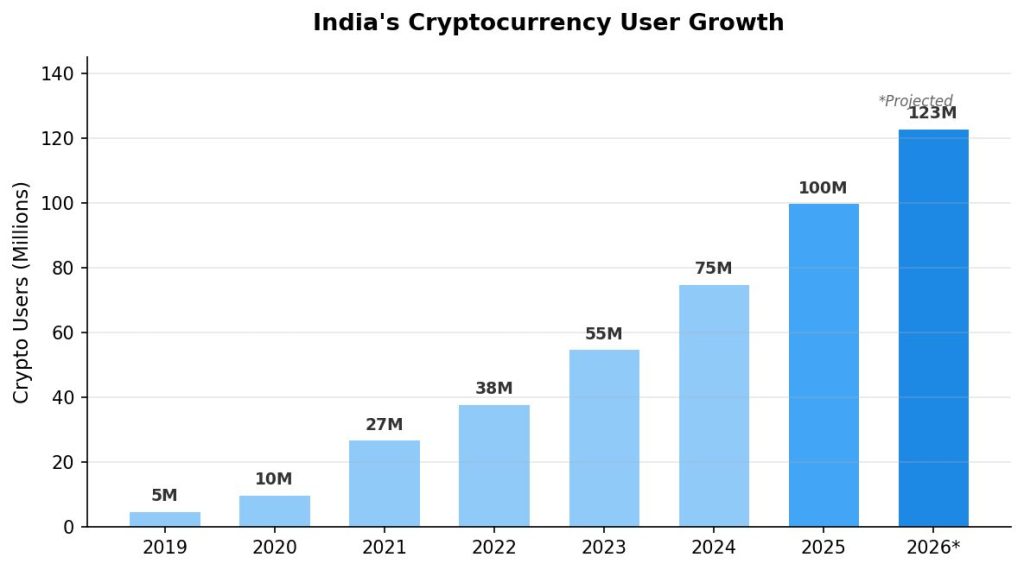
Third, India’s own crypto market has grown too large to ignore. With over 100 million cryptocurrency users as of early 2026, India’s domestic crypto market has become a meaningful part of the financial ecosystem. When crypto prices fall sharply, the wealth effect hits consumer sentiment, which in turn affects earnings expectations for Nifty-listed companies — particularly in the financial services and technology sectors.
What March 2026 Revealed About Both Markets
The Iran–US conflict that began with airstrikes on February 28, 2026 and escalated to the closure of the Strait of Hormuz on March 4 provided the clearest real-time test of how deeply these two markets are now linked.
Bitcoin fell from $74,000 to $66,000 in four trading days. GIFT Nifty futures, which trade on Singapore Exchange and serve as the primary pre-market indicator for India’s equity session, dropped from 23,200 to 21,760 over the same period. Both recovered to near pre-crisis levels by March 21, following almost identical recovery curves.
The pattern was not random. Oil imports account for roughly 28% of India’s total import bill, making the Indian economy — and by extension, the Nifty 50 — acutely sensitive to crude price spikes. Meanwhile, the $80-per-barrel Brent threshold has emerged as a critical level for Bitcoin: above it, Federal Reserve rate cut expectations evaporate, removing a major tailwind for risk assets. Below it, the path to monetary easing reopens.
In other words, both Bitcoin and Nifty now respond to the same macro trigger through different but converging transmission channels. Indian investors who monitor only one of these markets are seeing half the picture.
The Portfolio Allocation Evidence
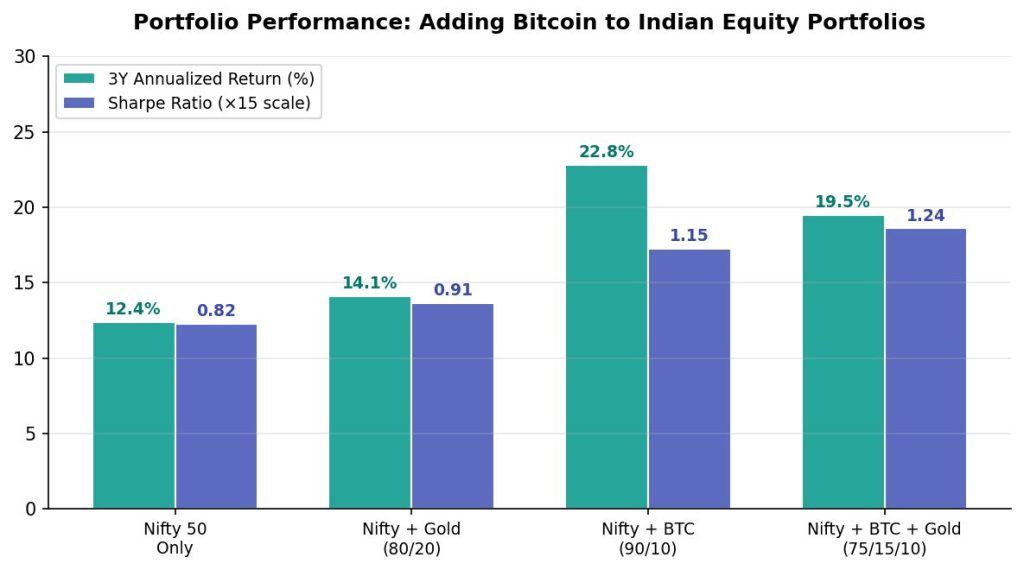
For Indian investors, the practical question is not whether Bitcoin and Nifty are correlated — they increasingly are — but whether adding Bitcoin exposure to an equity-heavy portfolio still improves outcomes. The answer, supported by backtesting data through Q1 2026, is yes, but with important caveats.
A portfolio of 90% Nifty 50 and 10% Bitcoin delivered a 3-year annualized return of 22.8% compared to 12.4% for Nifty alone. More importantly, the Sharpe ratio — which measures return per unit of risk — improved from 0.82 to 1.15. Even a conservative allocation of 75% Nifty, 15% Bitcoin, and 10% gold produced a Sharpe ratio of 1.24, the highest risk-adjusted return among all tested combinations.
The key insight is that despite rising correlation, Bitcoin’s volatility profile still adds diversification value during normal market conditions. The correlation spikes during crisis events, but in the 80% of trading days that qualify as “normal,” the correlation remains moderate enough to provide meaningful portfolio benefits.
Using Forecasting Tools to Navigate Correlation Spikes
The challenge for Indian investors is timing. When correlation spikes during crises, traditional diversification benefits temporarily vanish. This is precisely where AI-powered forecasting tools have become most valuable.
A bitcoin price forecast built on ensemble machine learning models — combining LSTM networks, XGBoost, and macroeconomic inputs like oil prices and DXY movements — can flag the conditions under which correlation is likely to spike before it actually happens. A study published in the Journal of Forecasting found that incorporating global economic drivers improved Bitcoin prediction accuracy significantly compared to crypto-only models, giving investors a critical early warning window.
During the March 2026 oil shock, ML models that incorporated geopolitical risk indices and oil futures data identified the elevated correlation risk 48 hours before the sharpest drawdown. Investors who used these signals to temporarily reduce either their crypto or equity exposure — or to hedge one position against the other — avoided the worst of the simultaneous sell-off.
This is not about predicting exact prices. It is about understanding when the correlation regime shifts from normal (where diversification works) to crisis mode (where everything sells together). That regime detection is something ML models do measurably better than human intuition.
The Indian Tax and Regulatory Angle
Indian investors navigating Bitcoin-equity allocation also face unique regulatory considerations that their global counterparts do not.
The 30% flat tax on crypto gains (with no offset against losses from other asset classes) remains in effect as of April 2026, though the government has signaled a potential review in the next Union Budget. The 1% TDS on crypto transactions above ₹50,000 continues to push liquidity toward offshore exchanges, though recent enforcement actions by the Financial Intelligence Unit have brought several international platforms into compliance with Indian regulations.
For portfolio allocation purposes, this means that the effective return threshold for Bitcoin exposure is higher for Indian investors than for their counterparts in jurisdictions with more favorable crypto tax treatment. A 10% portfolio allocation to Bitcoin needs to generate approximately 4.3% more annualized return than the equity-only alternative just to break even after the tax differential — a bar that Bitcoin has cleared over the past three years but that is not guaranteed going forward.
This is another area where AI-powered crypto predictions add tangible value for Indian investors. By providing probability distributions rather than simple directional calls, these tools help investors calculate expected after-tax returns across different allocation scenarios. A forecast that estimates a 72% probability of Bitcoin rising 15–20% over 90 days translates very differently into an allocation decision when you factor in India’s 30% crypto tax versus, say, the UAE’s zero rate.
What to Watch Through Q3 2026
Several factors will determine whether the Bitcoin–Nifty correlation continues tightening or begins to decouple:
- Oil price trajectory: If Brent crude settles below $80, expect both markets to rally but potentially decouple as domestic Indian factors (monsoon, RBI policy, earnings season) reassert themselves on Nifty.
- RBI digital rupee expansion: The Reserve Bank of India’s CBDC pilot now covers 5.2 million users. If expanded to cross-border settlement, it could alter the rupee-crypto dynamic that currently drives correlation.
- US crypto regulation: The GENIUS Act and OCC’s Letter 1188 have created regulatory clarity in the US. Any equivalent framework in India would likely increase institutional crypto adoption, initially raising correlation before eventually stabilizing it.
- FPI flows: Foreign portfolio investment into Indian equities reached $14.2 billion in CY2025. If these same investors increase crypto allocations, the rebalancing channel that drives correlation will strengthen.
The Bottom Line
The era of treating Indian equities and Bitcoin as unrelated assets is over. The data shows a structural shift in how these markets move together — driven by institutional overlap, shared macro sensitivities, and the sheer scale of India’s cryptocurrency user base.
For Indian investors, this does not mean avoiding Bitcoin. The portfolio evidence still supports a measured allocation. But it does mean that the traditional argument for crypto diversification — that it moves independently of everything else — needs updating. Smart allocation in 2026 requires understanding when correlation spikes, what drives those spikes, and how to use data-driven forecasting tools to position ahead of regime changes rather than reacting after the fact.
The investors who will navigate this best are the ones treating correlation analysis not as an academic exercise, but as a live input into portfolio decisions — updated daily, stress-tested against macro scenarios, and anchored in the same kind of quantitative discipline that has always separated long-term wealth builders from reactive traders.