
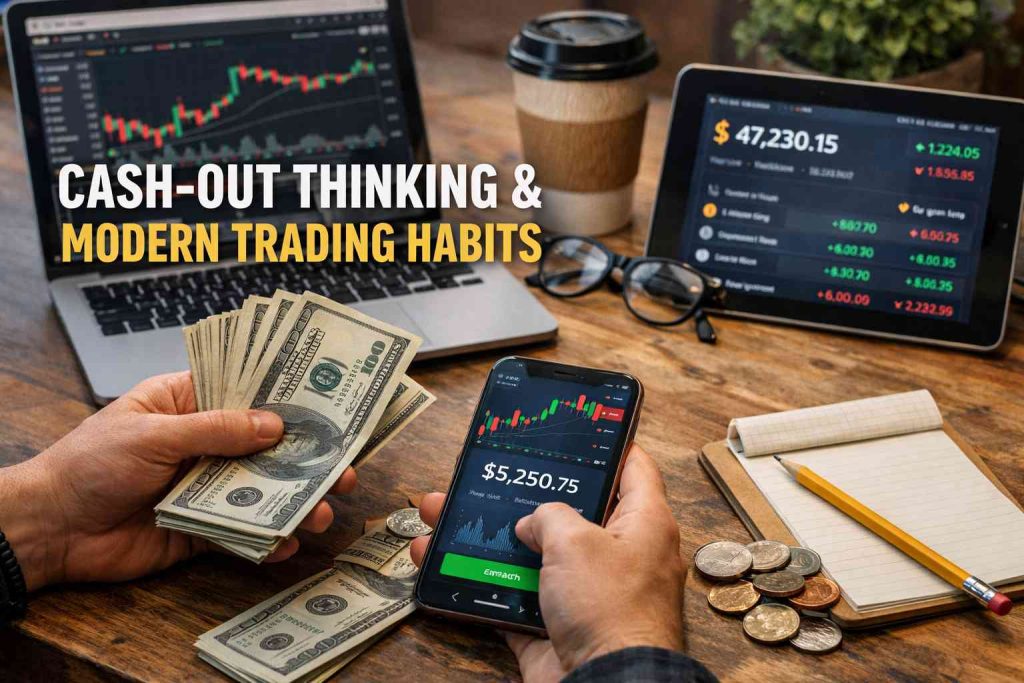
Real-time markets have changed how decisions feel. Prices update continuously, charts move like living objects, and alerts arrive with the urgency of breaking news. This environment rewards attention, but it can also reward calm structure. One of the most useful mental models for understanding behavior on live screens is “cash-out thinking” – the instinct to lock in a result now rather than stay exposed to uncertainty.
This mindset is often discussed as a risk, yet it also contains a positive lesson. Cash-out thinking reflects a desire for control, clarity, and defined outcomes. When that desire is guided well, it can support better discipline. When it runs unchecked, it can lead to early exits, late entries, and decisions made for emotional relief rather than strategy. A familiar example of fast, outcome-driven timing is the aviator india game style loop, where the choice is not only what to do, but also when to do it. Trading screens trigger a similar timing focus, only with more variables and more noise.
The goal is not to remove the instinct. The goal is to refine it into a healthy habit. Modern trading success is not only about information. It is also about timing behavior, attention hygiene, and the ability to stay consistent while the screen stays loud.
What Cash-Out Thinking Looks Like in Real Trading
Cash-out thinking shows up in everyday trading decisions in ways that feel rational in the moment. A position goes slightly positive, and the impulse appears to secure a win before it vanishes. A position dips, and the urge shows up to exit quickly to stop discomfort. In both cases, the mind is trying to reduce uncertainty.
This is not always a mistake. Locking in gains can be a valid approach when it matches a plan. Cutting losses early can be wise when risk rules are clear. The problem begins when the “cash out” choice is driven by mood rather than method.
Several patterns are common
- Profit-protection exits: closing too early because a win feels fragile.
- Relief-driven stops: exiting mainly to end the tension of being in the trade.
- Re-entry chasing: jumping back in immediately after exiting because the market continues moving.
- Outcome anchoring: treating the most recent tick as the most important piece of information.
These patterns often come from the same root. The brain prefers closure. Closure feels safe. Markets rarely offer clean closure in real time, so the mind tries to manufacture it through action.
A positive way to interpret this is that many traders are not lacking intelligence. They are managing emotion. Cash-out thinking is an emotion-management tool that needs a stronger framework.
How Live Charts and Alerts Train Timing Bias
Live charts create a powerful illusion. When information updates constantly, it feels like the next update contains the answer. This can create timing bias, where decisions become less about rules and more about catching the perfect moment.
Alerts intensify this effect. A notification is a trigger. It arrives with a built-in message that something important is happening now. That “now” feeling can override planning and pull attention into a reactive state.
Timing bias often develops through repetition. The screen teaches a lesson: act quickly and the result might improve. Sometimes that lesson appears true because fast reactions occasionally work. Those occasional wins strengthen the habit. Over time, the mind starts equating speed with skill, even when speed is simply responding to noise.
The most helpful reframing is that charts and alerts are tools, not instructions. They offer context, not commands. A trader who learns to treat live signals as information rather than orders gains an immediate advantage. The screen remains active, but decision pace becomes controlled.
A healthy trading mindset does not ignore real-time information. It interprets it through a plan. That plan is what transforms live updates from pressure into guidance.
The Habit Loop Behind Cash-Out Decisions
Modern trading behavior often follows a predictable habit loop. Understanding this loop makes it easier to improve outcomes without relying on willpower alone.
Trigger: a price jump, a sharp dip, a headline, an alert, or even boredom.
Action: enter, exit, move a stop, add size, or check the chart again.
Reward: relief, excitement, a sense of control, or the feeling of “doing something.”
The reward is frequently emotional, not financial. Even losing actions can feel rewarding if they reduce anxiety. This is why some traders keep trading after a stressful day. The goal becomes regulation, not performance.
A positive shift happens when the reward changes. Instead of rewarding action, the mind can be trained to reward process. Following rules becomes the reward. Executing a plan becomes the win. This sounds subtle, but it has practical impact. The trader stops needing every trade to feel emotionally satisfying because the system itself provides satisfaction.
Changing the habit loop does not require complicated psychology. It requires better triggers and better defaults. A checklist before execution. A timer that creates space. A rule that limits rapid re-entry. These are simple tools that reshape behavior in a measurable way.
Guardrails That Improve Discipline Without Slowing the Market
Speed will always be part of real-time trading. The advantage comes from building guardrails that keep speed from turning into impulsivity. The most effective guardrails are not restrictive. They are stabilizing. They protect attention and preserve decision quality.
Useful guardrails include pre-commitment rules that are set before emotion rises. When rules exist only in the moment, emotion negotiates them away. When rules exist beforehand, emotion has less power.
The following guardrails are especially effective because they fit real trading conditions without becoming burdensome:
- A two-step entry rule: a trade is only placed after confirming setup plus risk level.
- A fixed “no re-entry” window: after an exit, re-entry is delayed for a short period to prevent chasing.
- A position-size ceiling: size is capped per trade to keep emotion manageable.
- A single reason policy: every trade requires one clear primary reason, not a pile of weak justifications.
- A session boundary: trading is limited to a defined time block to reduce fatigue-driven decisions.
- A review ritual: quick notes after trades to reinforce process over outcomes.
These guardrails do not remove opportunity. They protect it. They keep the trader available for the best moments instead of exhausted by constant micro-decisions.
They also make cash-out thinking healthier. Exiting becomes a planned action rather than a reflex. Holding becomes a choice rather than a test of nerves.
Signals That Reveal Healthy Improvement Over Time
Progress in trading habits is often misunderstood as “winning more.” Winning matters, but behavioral stability is a better early indicator. A trader can improve discipline before results fully reflect it. That is good news because it means improvement can be measured and reinforced even during neutral market periods.
Several signals suggest that cash-out thinking is becoming more balanced:
- Fewer rapid reversals: less entering and exiting in quick bursts.
- More consistent timing: exits align with predefined levels instead of sudden emotion spikes.
- Reduced screen-check frequency: charts are checked with purpose rather than compulsion.
- Higher patience with noise: small fluctuations stop feeling like emergencies.
- Better emotional recovery: a loss does not automatically trigger immediate “make it back” behavior.
These signals can be tracked with simple journaling or platform analytics. The key is to view them as positive wins. They indicate stronger control, clearer thinking, and a more sustainable relationship with real-time information.
Cash-out thinking does not need to be eliminated to improve trading habits. It needs to be upgraded. When the desire for closure is guided by structure, it becomes risk management rather than panic. When timing pressure is filtered through rules, it becomes strategy rather than impulse.
Modern markets will continue to speed up. The strongest traders will not be the ones who react the fastest. They will be the ones who stay the clearest while the screen stays loud.